

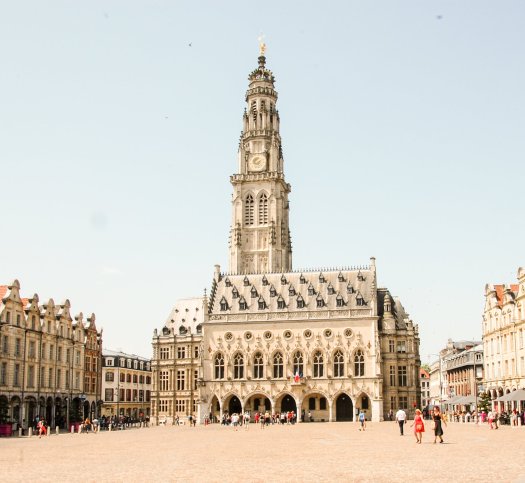
After our visit to Ayette cemetery we moved on to Arras. The city is built on a deep bed of chalk and limestone that from medieval times onwards provided the building materials for the homes, churches and public buildings. The city initially avoided damage by the advancing German army in 1915, but when the British won the town back a bombardment followed that demolished the towering spires for which Arras was famous and devastated some of the most beautiful Flemish style squares and buildings. The old town centre has been carefully and attractively restored to the exact plan and design of the original town and it is difficult to distinguish between the original buildings and the replacements of the 155 Flemish Baroque style buildings set around the Grand Place and Héros Square.
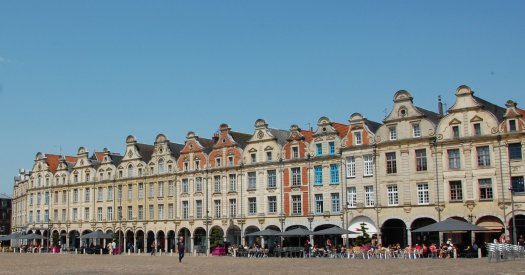
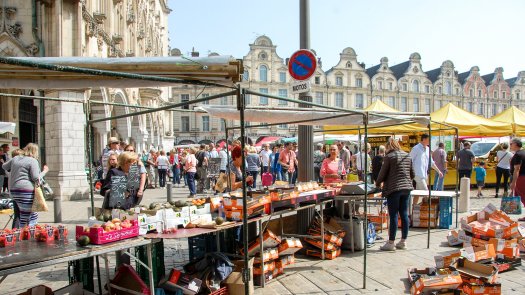
Saturday is market day in Arras and the two squares where thriving with stalls and shoppers in the hot sunshine when we arrived. The market finishes at 1.00pm and by 2pm you wouldn’t know it had been there!
The Belfry adjacent to the town hall was begun in 1463 and completed in 1554. From the exterior both it and the Town Hall have the appearance of being ancient buildings with Gothic arches, grimacing gargoyles, gold embellishments brightly shining in the sunlight. The Belfry has some wonderful views across the city – once you have negotiated the lift and spiral staircase!
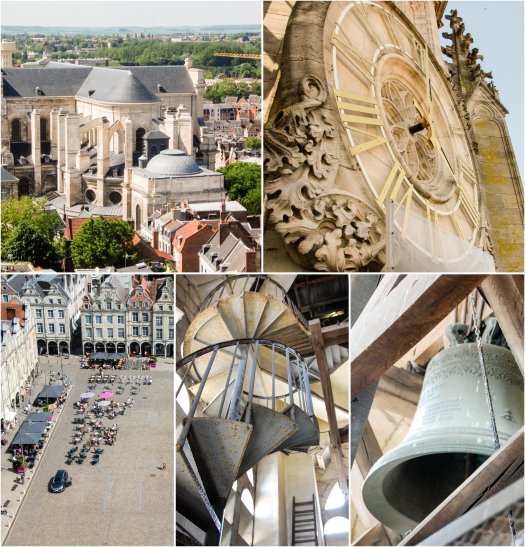
Under the Town Hall are “Les Boves”, a series of underground passages first dug out in the 10th century. They were used by wealthy merchants from the squares above to store their goods and save on taxes. In the 1st world war allied soldiers sheltered in them before the battle of Areas. In the 2nd, the townspeople used them as air raid shelters. The tour was interesting, they tipped their hat to health and safety, they haven’t been developed as much as some we have visited and it was damp under foot with big drips of water from the ceilings catching us several times!


Family time in the sunshine
We had a busy day planned for Sunday – Beaumont-Hamel Newfoundland Memorial, Albert and the Somme Museum, Ulster Tower and Thiepval.
The Beaumont-Hamel memorial is dedicated to the Newfoundland soldiers killed during the 1st World War. The Canadians have again retained the trenches over which the Newfoundland regiment made their unsuccessful attack on 1st July 1916 during the first day of the Battle of the Somme. As we walked through the trenches and down towards no man’s land and the German front line it was clear to see how exposed the Newfoundlanders were to the enemy – just a slaughtering field. The assault lasted 30 minutes and the regiment was all but wiped out. You can still see the stanchions that the barbed wire was fed through.
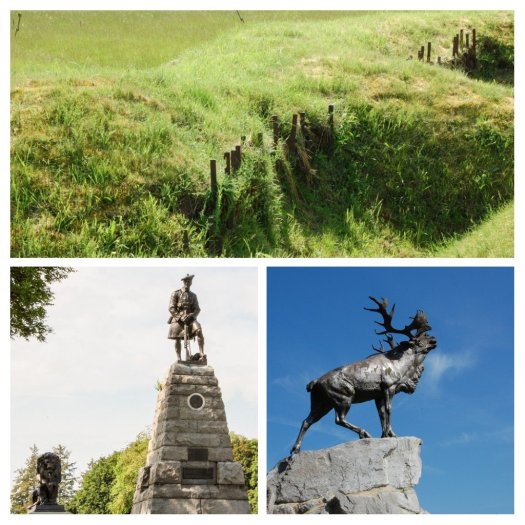

The memorial is a bronze caribou, the emblem of the Royal Newfoundland Regiment, standing atop a cairn of Newfoundland granite facing the former foe with head thrown high in defiance.
Also on the site is a memorial to the 51st Highland Division. It overlooks the Y Ravine, a scene of fierce fighting for the Division on 13 November 1916. The figure faces east towards the village of Beaumont-Hamel and is inscribed in Gaelic La a’Blair s’math n Cairdean – Friends are good on the day of battle. It was infested with a school group during our visit – not easy getting a photo without people in it!

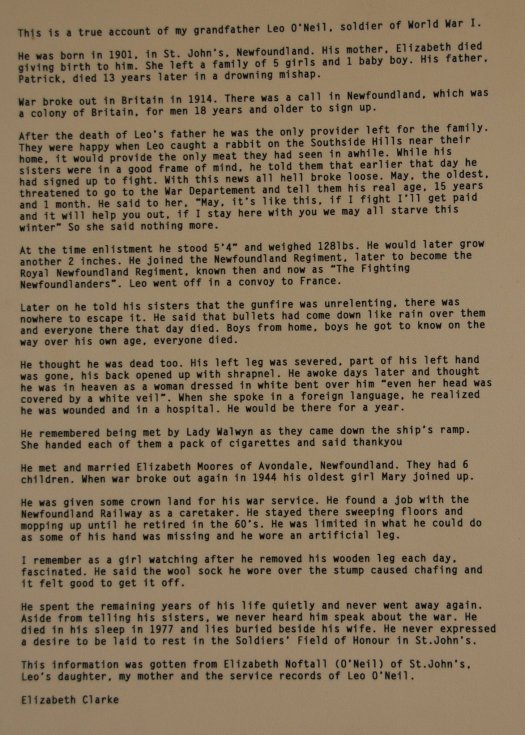
There is a small exhibition centre at the entrance to the site with documents the impact the First World War had on the people of Newfoundland and Labrador both at home and overseas, through the stories, photographs and mementos of the people who lived it. I found the following recollection very moving….
Moving on we next visited Albert and the Somme Museum.
Albert was the main town behind the lines for the Allies on the 1916 Somme battlefields. It was devastated during the war and rebuilt afterwards. The Golden statue on top of the Basilica was visible from far away and an excellent target for enemy artillery. It was damaged in January 1915 when the statue was knocked from the pedestal but stayed leaning at an angle. A superstition grew up among the soldiers that the war would end only when the statue fell. It remained in that position the whole time the town was in French and British hands. During their Spring Offensive in 1918 the German’s advanced into Albert. Aware that the tower could be used as an excellent observation point, the British artillery deliberately targeted it and the statue finally fell. Four months later Albert was retaken by the British, and three months after this the war was over!!
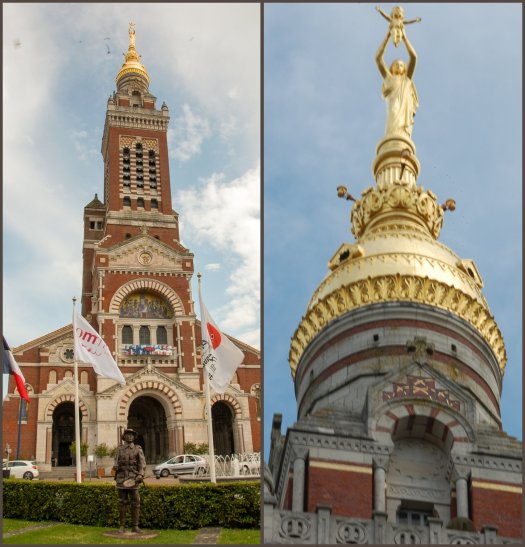
To the right hand side of the Basilica is the entrance to the Somme 1916 Museum. Ten metres underground, in tunnels dating back to the middle ages, there is an excellent display of weapons, artefacts, photographs and Dioramas of life in the war and in particular the tragic offensive of the 1st July 1916. It covers over 250 metres in length. I thought it was the most amazing collection and presentation…. certainly well worth the visit. Hopefully the pictures will speak for themselves!
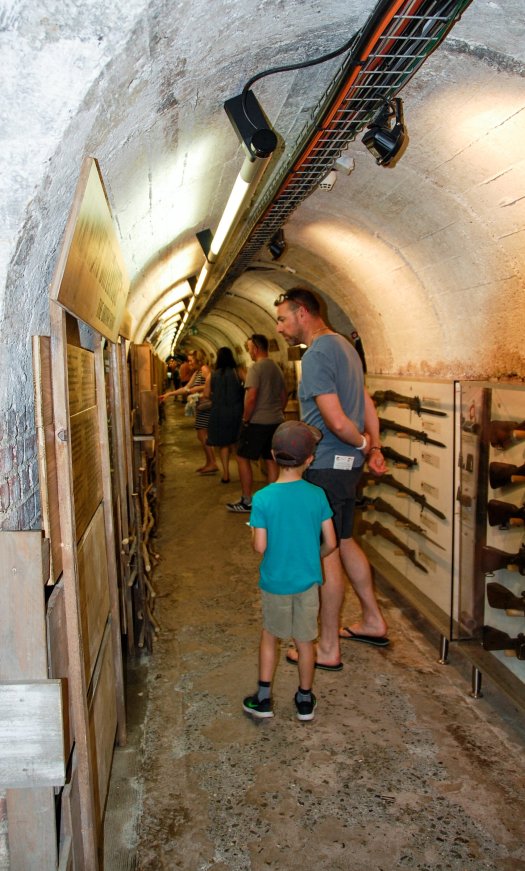
These kids just loved the place…
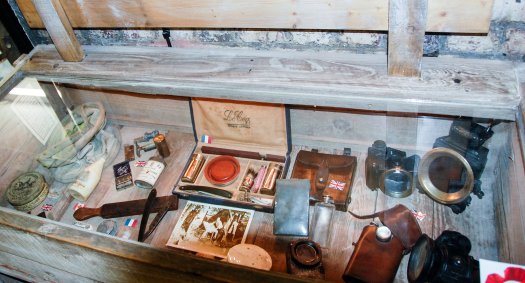
The cabinets were fascinating with all sorts of artifacts and displays.
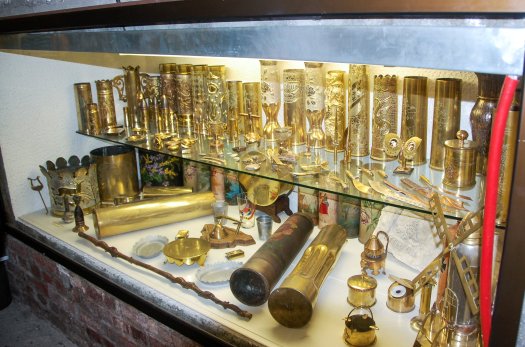
This is a display of items made by soldiers in the trenches… What else could you use bullet casings for?


Communications are very important…. these guys are from the Ulster division, note the sashes!!

Prepared for gas attacks
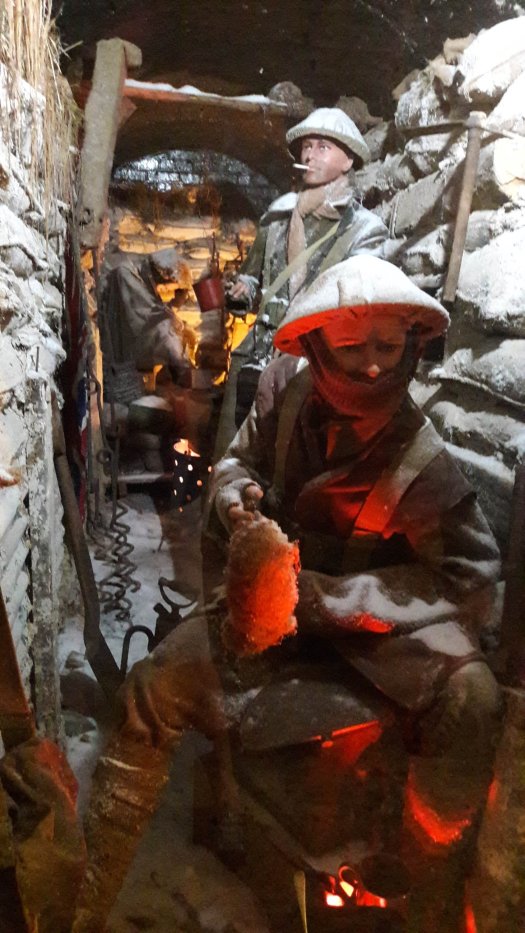
The trenches in the winter – rats as big as cats!
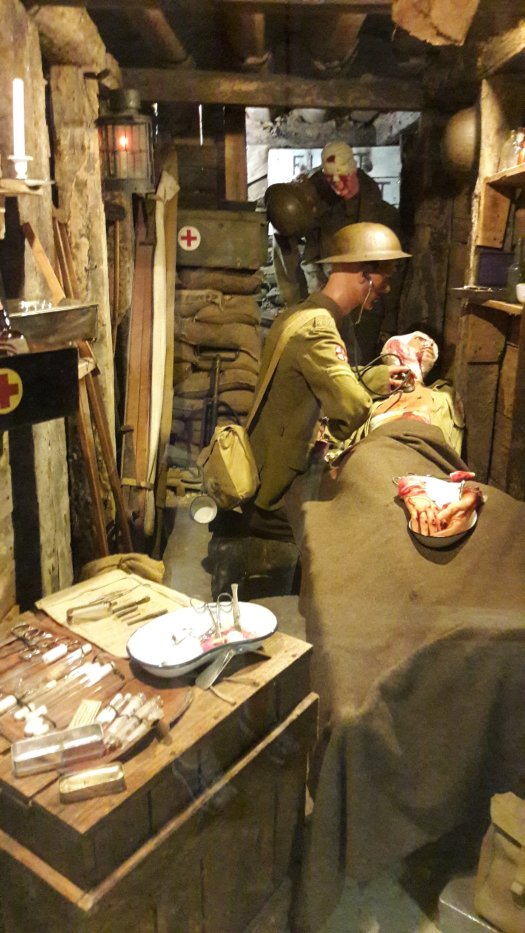
Emergency hospital
After a not very inspiring lunch we moved on to the Ulster Tower. I’m not going to rehearse the story of the Ulstermen at the Battle of the Somme. If you don’t know it, Google it!
A memorial now stands upon the ground where men from Ulster fought and died. The Ulster Tower is a replica of Helen’s Tower from the Dufferin and Ava Estate at Clandeboye, where the Ulster Division
During our visit to the Somme Centre in Newtownards the guide recommended that we book a tour to Thiepval wood, which is opposite the Tower, so we rocked up for our 3pm tour. Nothing was discussed about the tower itself and the group was escorted a short distance up the road to the wood.
The original trenches inside Thiepval Wood, which marks the front line battle ground of the 36th (Ulster) Division, have been excavated and preserved. This is a work in progress, the land now is owned by the Somme Association. The trenches had originally been dug by Scottish regiment and therefore had been given Scottish names… tickled that Paisley was included!

Thiepval Wood trenches
A story was recited of gas being used from the wood, up a sap towards the German’s lines. This depended on the wind being in the right direction! In the end the tactic wasn’t used. Cylinder s were recovered during excavations in 2007.
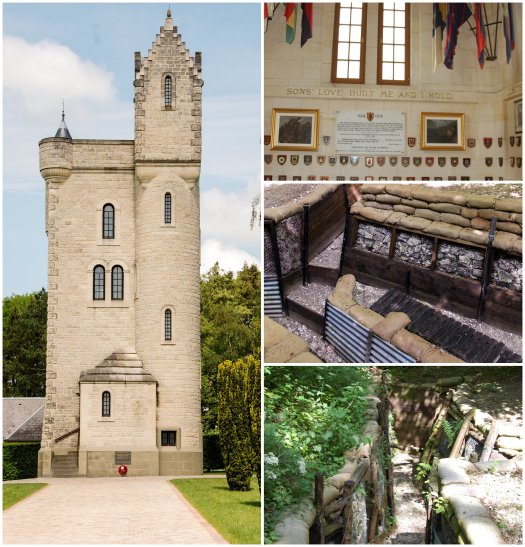
Our next stop was the Thiepval Memorial. On the high ground, overlooking the Somme River, the tower, over 45 metres in height, dominates the skyline for miles around. It commemorates more than 72,000 men of the British and South African forces who died in the Somme sector before 20 March 1918 and who have no known grave. The majority having lost their lives in the 1916 Somme offensive. It is huge!


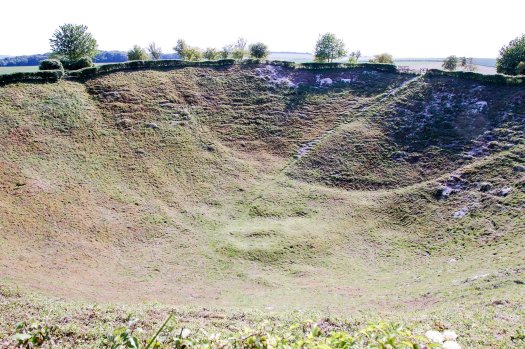
Our final stop was at the Lochnagar Mine Crater Memorial, the largest manmade mine crater created in the First World War on the Western Front. It was laid by the British 179th Tunnelling Company Royal Engineers underneath a German strong point called “Schwaben Höhe”. The mine was exploded two minutes before the 0730am zero hour at the start of the Battle of the Somme offensive on 1st July 1916. Despite the successful blowing up of the mine and damage to the strong point, the German’s managed to get in to good position to fire at the advancing British troops killing many hundreds within the first half hour of the attack. The mine is now the private property of an Englishman who bought it to preserve the site and the memory of those lost. He organises a work party the second May Bank Holiday weekend every year to carry out maintenance and tidy up the area. We just happened to be there while they were and met a lovely man whose father had died in the battle.
Monday we said goodbye to the cousins and headed towards Normandy. Our plan was to visit the beaches and stay overnight in Bayeaux. The overnight rain had flooded some of the villages and the roads were extremely muddy early on in the journey.
We stopped at a carwash and gave Daisy the once over, driving on to let her drive off! A short time later we stopped at a lovely windmill to take a photograph and put the roof down – disaster struck!
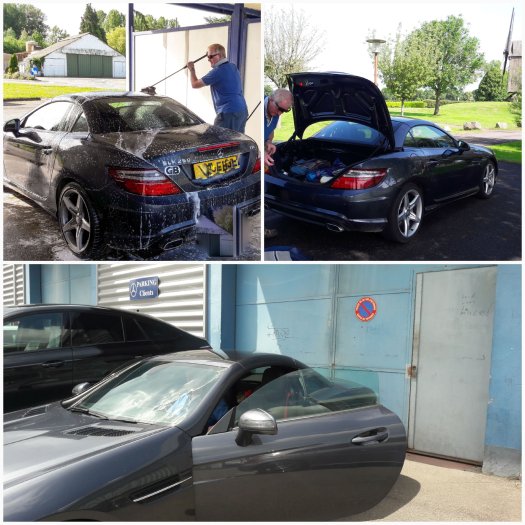
We couldn’t get the boot to lock shut! It appears that the shunt we suffered a fortnight ago has hurt my baby! She hung on as long as she could but no more…. So for 40+ miles we traveled to another Mercedes dealer with our fingers and toes crossed the lid wouldn’t pop up! The scenery was stunning but it was wasted on us! With much use of hand signals, and pointing at stuff we managed to explain our problem as did they!! €40 lighter in the pocket they jury-rigged the catch so we can at least lock the car! No more roof down this trip….
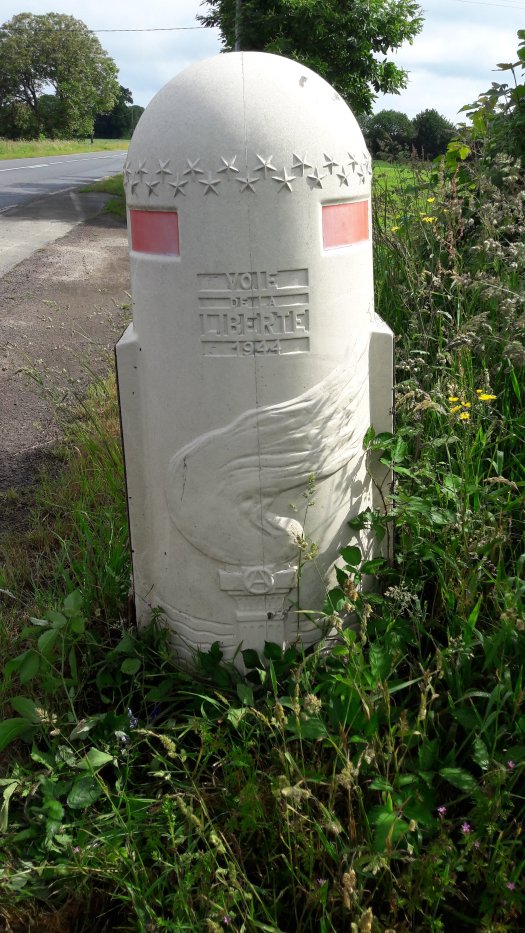
The route we took was called “route de la voie de la liberté”, Liberty Road. It is a commemorative way marking the route of the Allied Forces from D-Day in June 1944. Starting from Utah beach in Normandy it travels through France, Luxembourg and Belgium. Each kilometre is is marked with a stone or “borne” engraved with a flaming torch of liberty emerging from the sea.
Arriving much later than expected in Bayeaux it was out for dinner and back to bed!
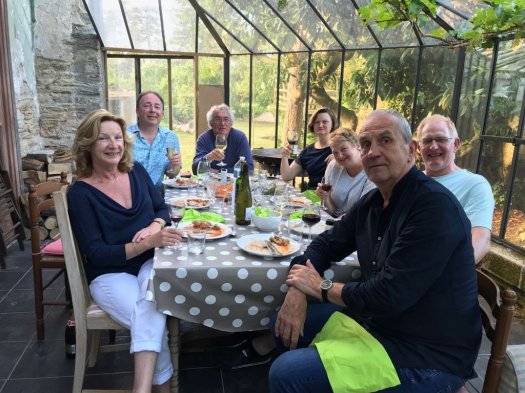
The decision next morning was should we do the town and beaches and arrive later with Sara and George in Malestroit, our last stopover of this trip or rattle on and come back this way again? We decided to head on (the plan is brewing for another adventure). How glad were we that we did….. Arriving in Malestroit just before 1pm, we parked in the square as directed and Sara came out to meet us – narrow streets, not much space was the reason given. As we parked I spied another English SLK…. Oh look!! Still oblivious to anything untoward! We got in to the house , hugging George, chittering away when Sara opened the door at the opposite end of the kitchen and in walked Kate & Tony from Yorkshire and Katherine & Chris from Wiltshire…. that led to some squeals, tears and lots of hugs. Both these couples had missed our retirement party because of the snow in March. It was just such a wonderful surprise. Paul met Sara, Kate and Katherine when he was on a public leadership course in the early 2000’s and we have kept in touch ever since. So made up that we are all together for the last days of our holiday.
 H&P Adventures